Death of Elizabeth II
Player Manager: A Sports Progression FantasyThe Death of Elizabeth II becomes a sudden interruption to the football world and to Max Best’s precarious attempt to build a life through the sport. The announcement reaches him at Broadhurst Park with the stark declaration that Her Majesty the Queen is dead, and its immediate consequence is the suspension of football across England and beyond. For Max, the event is both a national rupture and a personal disaster: without matches, there is no experience, no XP, no obvious route to finding a club for Ziggy Graves, and no escape from the call centre that he fears may define the rest of his life.
The Announcement and Max’s First Reaction
The news arrives while Max is pursuing football opportunities in person. He has already decided that telephone calls will not be enough, and has driven to Broadhurst Park after work because face-to-face pressure might persuade a club to give his player a chance. His search has led him down the football pyramid to FC United of Manchester, a club founded by former Manchester United supporters who rejected the transformation of fans into customers and wanted to recover a more direct relationship with the game.
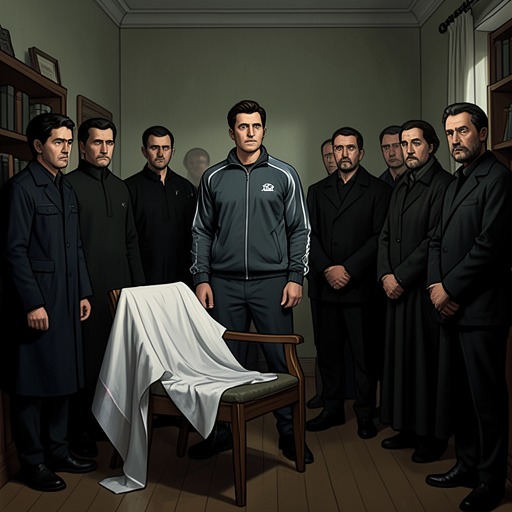
That practical mission ends when the grey-haired man tells Max that the Queen has died. Max’s private response is deliberately presented as selfish and unbecoming: his first thoughts concern cancelled football, lost XP, the impossibility of finding a club for Ziggy Graves, and the prospect of remaining in a call centre forever. The reaction is irrational, but it is also consistent with the way Max understands the world. Football is not a pastime placed safely below national history; it is the system through which he measures progress, opportunity, identity, and hope.
The scene then widens from Max’s comic panic to the older man’s historical grief. He regards Elizabeth II as a constant presence across ninety-six years of life and seventy years as monarch, head of state, and commander-in-chief. His recollection moves through planes, phones, fashion, music, Christmas broadcasts, currency, and the 1966 World Cup, when she presented the trophy to the England team. The Queen’s death therefore signifies the passing of a figure who has functioned, for him and for much of Britain, as a fixed point amid enormous social and technological change.
Football in Mourning
The sporting consequences are immediate and unusually broad. Flint Town United against Aberystwyth Town is postponed, as are Tottenham Hotspur against Manchester City and every other match in England. The suspension reaches the Scottish league, non-league football, and children’s fixtures; even nine-year-olds are not permitted to play. The narration summarizes the result in a compact national image: football is in mourning.
The decision is made more conspicuous by the fact that other sports continue. Cricket and golf proceed alongside less conventional activities such as dog frisbee and extreme ironing, allowing their supporters to gather and honour the Queen collectively. Football, by contrast, is treated as a social danger. The contrast implies that the sport associated with working people is not trusted to behave properly in a public moment of grief. Its supporters are imagined as brutish and boorish, capable of making a mess where other sporting audiences are presumed capable of collective dignity.
The narrative rejects that assumption while preserving its uncertainty. Max insists that football supporters would have behaved impeccably, but the cancellation prevents anyone from discovering whether that confidence was justified. The event thus produces not merely mourning but exclusion: football fans are denied the opportunity to demonstrate their own form of public respect. Institutional caution becomes a judgment about class and culture, and the suspension reveals how quickly a national ritual can divide citizens into audiences considered respectable and audiences considered suspect.
Personal and Institutional Consequences
For Max, the cancelled fixtures interrupt several ambitions at once. His advancement depends on matches because matches generate the XP through which he understands his strange footballing capabilities. They also provide access to clubs and players. The stoppage threatens his attempt to place Ziggy Graves, stalls his own development, and turns his fear of permanent call-centre employment into an immediate possibility. His apparently petty response is therefore attached to real material stakes, even though he initially lacks the emotional perspective to recognize the scale of the death around him.
The broader plot later shows how football organizations are governed by competing obligations that the royal mourning period temporarily overrides. FC United of Manchester’s community origins, Chester FC’s community ownership, the authority of City Fans United, sponsorship income, youth development, and competitive ambition all depend on football continuing as an organized social practice. Mike Dean’s explanation that Chester FC exists to survive financially, while remaining answerable to its community and supporters, clarifies why football is more than a series of isolated fixtures in this world. When the game stops, an entire network of economic, civic, and personal relationships is suspended with it.
The event also stands in contrast to the later accessibility debates surrounding the Chester Knights’ pan-disability football. That competition demonstrates how football can create games, pathways, recognition, and community for players with different impairments. The Queen’s death, however, produces a different kind of interruption: not an adaptation that brings people into play, but an institutional cancellation that removes everyone from it. The juxtaposition helps define football as a public structure whose value lies in repeated participation, not only in elite spectacle.
Narrative Significance
The Death of Elizabeth II exposes the instability beneath Max’s football-centred worldview. His response first appears morally inadequate because he translates a national death into lost XP and professional inconvenience. Yet the scene does not simply condemn him. The older man’s grief and Max’s embarrassment coexist, and Max eventually apologizes for trying to promote his player at the wrong moment before leaving to give the man space. His movement from self-absorption toward recognition is small, awkward, and credible rather than ceremonially noble.
The event also deepens the novel’s treatment of the curse. Max later realizes that the curse is shaped by his own football opinions as much as it shapes him: its terminology, its rewards, and its judgments reflect the prejudices he carries. The same realization makes the death episode retrospectively important. Max’s comic fixation on football does not remain outside the moral world; it becomes evidence of the values through which the curse operates. The interruption therefore functions as a test of character, revealing that his passion can be both a source of purpose and a vehicle for selfishness.
Finally, the postponements place royal continuity and football continuity in uneasy parallel. The older man describes Elizabeth II as constant as the North Star, while Max experiences football as the constant that organizes his immediate future. Her death removes one form of national stability just as the suspension of the game removes another, leaving Max without the routines by which he has been trying to reinvent himself. The event is consequently both public history and private dislocation: a moment when the country pauses, football disappears, and Max is forced to see how much of his identity has been built upon the assumption that the next match will always take place.